Why the Racing Line Changes from Corner to Corner
Learn why the racing line changes from corner to corner, and how turn shape, grip and track position affect a driver’s choices through each bend.
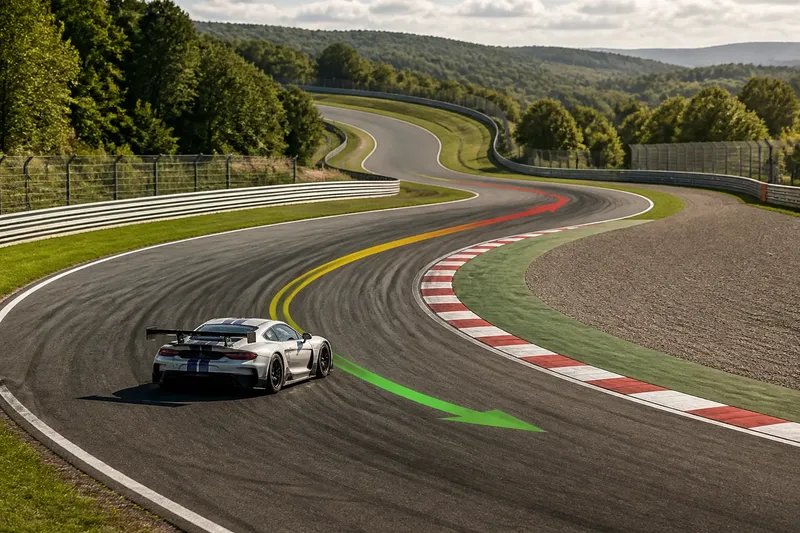
A car turns into a tight bend, clips the inside and runs towards the outer edge. At the next corner, that same route may leave the driver badly placed. The racing line changes from corner to corner because a driver must weigh the turn’s shape, available grip, visibility and the space needed afterwards.
What does the racing line describe?
The racing line is the path a vehicle takes through a corner, from its approach to its exit. It is not simply the smoothest-looking strip of tarmac or the route closest to the inside kerb. Drivers choose where to position the car before turning, where to point it towards the inside, and how to leave the bend while keeping control.
A familiar reference is the outside–apex–outside line. The car begins towards the outside of the track, turns towards the inside point called the apex, and uses the available track width on exit. The apex may be a kerb or a point beside it; touching the kerb is not automatically the fastest or safest choice.
This description is a starting point, not a prescription. A corner may have more than one apex, a late apex, or a route that deliberately avoids the inside. The useful question is not “Where is the shortest path?” but “Which path lets the driver carry useful speed through this turn and leave the car in control?”
How does corner shape change the racing line?
A tight, roughly constant-radius corner asks the driver to slow, turn, and then accelerate as the car straightens. Using the track width can make the turn feel less abrupt: the car travels around a broader arc rather than pivoting sharply at the inside. In general, the driver aims to complete much of the turning before asking for strong acceleration.
A bend that tightens towards its exit calls for a different approach. If the driver commits to an early apex, the corner may keep closing after the car has passed it. The car can then run out of room or force the driver to reduce speed while still turning. Holding a little more distance from the inside at first can leave room to meet the tighter part and finish the corner under better control.
A corner that opens out can reward a line that gets the car turned early and allows it to unwind towards the exit. A late apex is not a universal cure for a difficult bend; it is useful only if the bend’s shape and available space support it. Camber, bumps, kerb shape and changing grip can all make the apparent geometry misleading.
How does the track beyond the corner affect the line?
If a long straight follows, the driver may prioritise a clean exit and early acceleration over carrying extra speed at the corner’s entry. A small loss on entry can be worthwhile if it leaves the car pointing down the straight sooner, with room to accelerate.
For a sequence of bends, the driver may give up an ideal path through the first corner to prepare for the next. Consider a left-hand bend followed closely by a tighter right-hander. Running wide on the left’s exit may place the car on the outside for the right, making it easier to turn in without crossing awkwardly over the track.
That compromise is specific to the sequence. A position that helps with the second bend may leave little room for a third, or may expose the car to another competitor. Watch where the car needs to be after each turn, then consider whether the route leaves enough space for the following manoeuvre.
What do grip and visibility change?
Grip is not identical across every part of a circuit. The racing surface may be dusty away from the common path, while rubber laid down by repeated laps can make another section more usable. Rain can alter that balance, and standing water or a slippery painted surface may make a familiar route unattractive. Drivers adjust to the surface rather than assuming yesterday’s line still applies.
Visibility matters too. A crest can hide the exit, while a barrier, another car or a change in elevation can limit what the driver can see. In those circumstances, a theoretical ideal apex may matter less than choosing a path that leaves room to react. A track walk, onboard footage and braking or turn-in references can help a driver understand the corner, but conditions still need to be judged on the circuit.
In a race, another vehicle changes the available choices. A driver defending the inside may leave little room there and force the following car to consider a different entry or wait for a later opportunity. Traffic makes space, visibility and a predictable path part of the decision.
How do drivers choose an apex?
The apex is the point where a car comes closest to the inside of a turn. An early apex means reaching that point sooner; a late apex means reaching it later. The distinction affects the car’s direction as it leaves the corner, so drivers choose an apex in relation to the turn and available exit space rather than treating the kerb as a target.
A useful way to read a corner is to work backwards from the exit. Ask where the car needs to be when acceleration becomes important, then consider what entry and apex position will allow that. If the exit is narrow, a line that leaves room to straighten the steering may be preferable to one that reaches the inside early and pushes the car towards the edge.
Say a driver approaches a broad right-hander that feeds onto a straight, but the exit kerb is rough and the usable track narrows beyond it. The driver chooses a later apex, then opens the steering only as the car settles. The expected observable result is a tidy exit with the car positioned for acceleration, while the rough edge remains unused.
Why might a driver avoid the shortest line?
The shortest route is not necessarily the quickest route. A very direct path can require a sharper turn, more braking or a longer wait before acceleration. A slightly longer arc may let the car maintain a smoother path and leave the corner pointed in a useful direction. The balance depends on the vehicle, tyres, surface and conditions.
There are also practical reasons to leave space. A kerb may unsettle a car, the edge may be dusty, or another competitor may occupy the preferred part of the track. A driver can choose a more conservative route to keep the car stable, protect room for a move or avoid an abrupt correction.
What is not worth the effort is memorising a universal rule such as “always hit the apex” or “always use all the track”. Those slogans ignore the difference between corners. Instead, identify the turn’s shape, check where it leads, and notice which surfaces offer usable grip.
What questions do readers ask about the racing line?
Is the racing line always the fastest line?
It is a common description of an efficient route, not a fixed path that works in every condition. Traffic, weather, grip, vehicle behaviour and the circuit layout can all change which line is useful.
Does every corner have one apex?
No. Some bends have a single clear apex, while a long or changing-radius turn can have more than one useful reference point. A driver may also avoid the nominal apex to improve the exit or leave room for another car.
Should a driver touch the kerb?
Only when the kerb’s shape and surface suit the car and intended path. A kerb can help widen the usable route, but it can also disturb the car or lead onto an unsuitable surface.
Why does the line change in the wet?
Water changes the grip available in different parts of the track, and a rubbered-in path may become slippery. A driver may look for a more predictable surface and use gentler steering, braking and acceleration.
How can you read a racing line while watching?
Watch where the car is positioned before the turn, not only where it passes the apex. Then follow its exit: does it use the full track, leave room, or arrive at the next bend on a different part of the circuit? This makes the driver’s choice easier to understand than treating each corner as an isolated turn.
For a quick comparison, pick two corners with different jobs. One might lead onto a straight, while another forms part of a linked sequence. Notice whether drivers delay their turn-in, change their apex or leave more track unused. The racing line changes from corner to corner because drivers respond to different demands, not because one painted route dictates every move.
When a car takes an unexpected path, look for the reason in the exit, the surface or the space around it before calling it a mistake. A line that looks unusual from the outside may be a way to manage a kerb, keep room for traffic or avoid a blind patch of track.