The Open-Wheel Idea and the Shape of a Racing Car
Open-wheel racing car design reveals how the cockpit, suspension and tyres fit together, so you can identify the layout and read visible movement at the track.
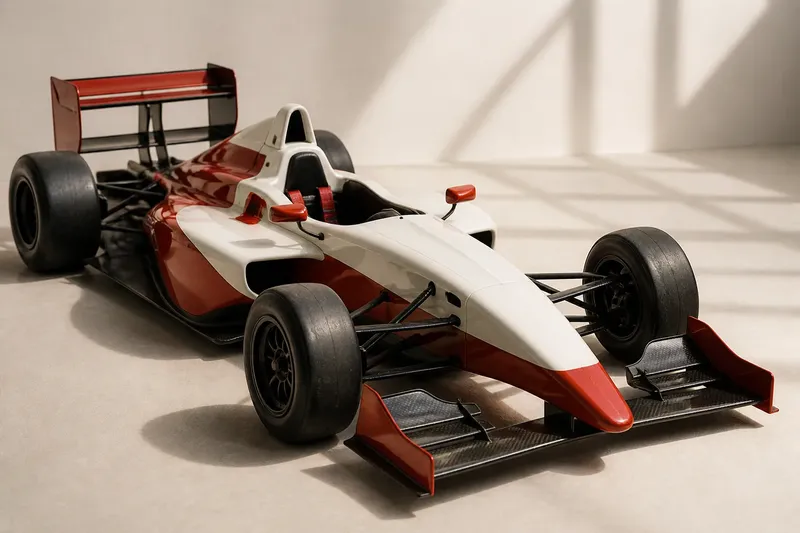
A single-seater turns into a corner, and its front tyres angle towards the apex while the nose stays between them. That familiar outline is the quickest clue to open-wheel racing car design: the tyres sit outside the main bodywork, with suspension links connecting them to the chassis.
To read the shape, look beyond the tyres themselves. The cockpit, nose, side structures and wings form a carefully shaped central package, while the exposed assemblies at each corner make steering and kerb contact easier to see.
What defines an open-wheel racing car?
“Open-wheel” describes the relationship between the tyres and the bodywork. Unlike an enclosed-wheel car, whose fenders cover the tyres and follow their outline, an open-wheel car leaves the wheels outside the central body’s enclosing panels.
The term does not mean the whole machine is bare. Bodywork surrounds the cockpit and mechanical components, and aerodynamic surfaces shape the nose, sides and rear. The distinction is specifically about how the tyres are housed.
From a three-quarter view, look for the suspension arms stretching between the chassis and each wheel. That exposed connection is part of the car’s visible structure, not a detail hidden behind a fender.
Why does the car have a narrow centre?
The chassis carries the driver and joins major mechanical components, while the wheels sit at the four corners. This arrangement gives the car a slim central section and makes the distance between its left and right wheels—the track—easy to pick out visually.
The nose tapers towards the front, and the rear bodywork packages the power unit and transmission. Wings and side structures can make the silhouette look broad, but they do not enclose the tyres in the way fenders do on an enclosed-wheel machine.
On a touring or sports car, the body often reads as a continuous shell around the wheel openings. On an open-wheel car, the cockpit and mechanical package form the centre of the outline, with each wheel assembly clearly separated from it.
What can exposed wheels tell you at the track?
Watch the front tyres as the driver turns. Their changing angle makes steering input visible, while the suspension arms show how the wheels connect to the chassis. The details vary between cars, so use what you can see to describe movement rather than to guess at a particular setup.
Kerb contact is another useful cue. A wheel may rise or move relative to the body as the car crosses a kerb, making the response easier to follow than it would be behind a fender. A tyre’s apparent movement alone does not explain its grip or the forces acting on it; compare it with the body’s motion and the track surface.
Imagine you are watching a car cross a painted kerb on the inside of a bend. The near-side wheels rise as the car passes over it, and the chassis follows with a small change in attitude. You can describe that visible sequence, but the view does not reveal the car’s exact settings or the forces involved.
How should you compare open-wheel and enclosed-wheel cars?
Start with the fenders. Enclosed-wheel cars have bodywork around the tyres, even if vents or gaps leave other mechanical parts visible. Open-wheel cars keep the wheels outside that enclosing bodywork, while still using substantial panels around the cockpit and machinery.
Then look at what each shape lets you observe. Open-wheel layouts make the corners of the car, front steering angle and suspension connections prominent. Enclosed-wheel bodywork gives the vehicle a more continuous side profile, so the wheel’s position and movement may be less apparent.
Neither label tells you every detail of construction or performance. It identifies a bodywork arrangement; it does not, on its own, explain how a car will behave on a particular circuit.
What questions help identify the layout?
Are open-wheel cars always single-seaters?
Many familiar open-wheel racing cars have one seat, but the words describe different features. “Single-seater” refers to the cockpit, while “open-wheel” refers to the way the bodywork relates to the tyres.
Does open-wheel mean there is no bodywork?
No. The nose, cockpit surround, side structures and aerodynamic surfaces are all shaped by bodywork. The defining point is that fenders do not enclose the tyres.
Why can you see the front wheels turn?
The front tyres sit beside the central body rather than behind wheel arches. From trackside, their angle can show when the driver starts to steer into a corner.
Can an enclosed-wheel car have visible suspension?
Yes. The label concerns the bodywork around the tyres, not whether every mechanical part is covered. A car may show suspension or have open vents while its fenders still surround the wheels.
What should you check before naming the design?
Use these observations to make a clear identification. If a feature is obscured by the camera angle, choose a better view rather than guessing.
- Check whether body panels cover the tyres’ outer portions; if they do, describe the car as enclosed-wheel, and if they do not, check the other clues before calling it open-wheel.
- Check whether each tyre sits beyond the central body’s outline; if it does, look for visible suspension links, and if it does not, find a side or three-quarter view before deciding.
- Check whether the front tyres visibly change angle during a turn; if they do, note the steering movement, and if the view is unclear, avoid inferring steering from the car’s direction alone.
- Check whether fenders connect visually to the side panels around the wheel openings; if they do, the layout is enclosed-wheel, and if they do not, inspect the rear as well before classifying the car.
- Check whether visible arms link the chassis to the wheel assemblies; if they do, use them to describe the suspension’s movement, and if they are hidden, do not assume the car lacks suspension components.
- Check whether the image shows the whole car or only a close crop; if it shows the whole outline, make a provisional identification, and if it is cropped, seek a wider view before reaching a decision.
What is not worth inferring from the shape?
A visible suspension link does not reveal a team’s setup, and a slim-looking body does not tell you how much grip the tyres have. Use the silhouette to identify the design and describe movement; leave claims about performance to information specific to the car and series.
It is also not worth treating “open” as a sign that the car is unfinished or mechanically bare. The term describes a deliberate bodywork arrangement, not the quality or completeness of the engineering.
When comparing racing cars, open-wheel racing car design gives you a useful first question: are the tyres enclosed by the bodywork, or does the central structure leave them as distinct assemblies? From there, you can describe what the suspension and steering visibly do without claiming more than the view supports.