The Checkered Flag and How It Became Racing’s Finish Signal
Learn what the checkered flag means, how the tradition developed, and how to follow a race’s finish without confusing the signal with the official result.
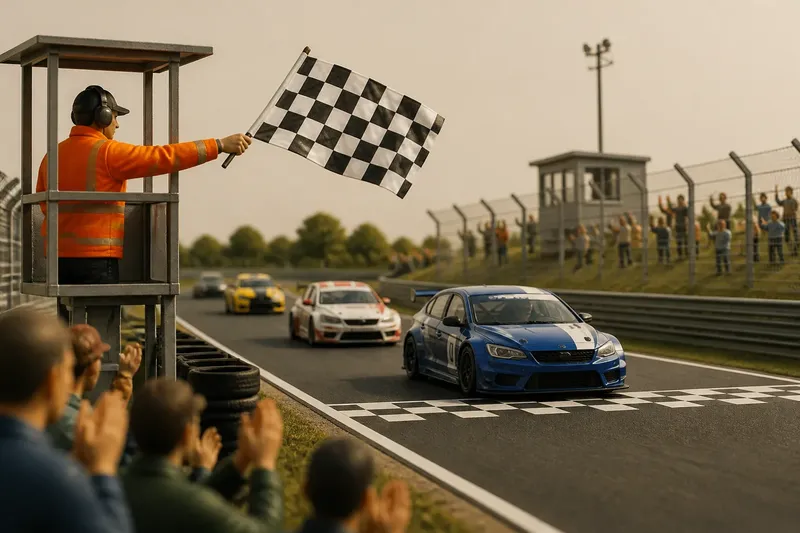
A marshal raises a chequered flag as the leading car reaches the line, and the crowd begins to clap. The checkered flag is the familiar racing finish signal, but its history is less tidy than the pattern suggests: it became tradition through repeated use, rather than through one settled origin story.
What does the checkered flag mean at a race finish?
In many forms of motor racing, the chequered flag signals that the scheduled race has reached its finish condition, commonly when the leader crosses the line. It gives drivers and spectators a clear visual cue. The precise procedure depends on the competition’s regulations and instructions from officials.
The flag does not tell every driver to stop immediately. Depending on the event, competitors may need to continue around the circuit, slow down, return to the pits or follow another directed route. Drivers should follow the briefing, signals and officials’ directions rather than assume a procedure from another series.
Nor does the flag, by itself, settle every question about the result. Timing records and the event’s rules are used to determine classification, including any relevant penalties or disputes. The flag marks the finish; the formal process establishes the result.
How did the chequered finish tradition develop?
There is no universally accepted account that pins the chequered flag’s origin to one person, race or invention. Early motor competitions did not all share a single system for communicating with competitors. As events developed, officials used visible signals to direct cars, and the contrasting squares became associated with the end of a contest.
The pattern’s appeal is easy to understand. Alternating light and dark squares are distinctive against many trackside backgrounds, and a flag can be recognised from a distance without reading a sign or hearing an announcement. Those qualities made it a practical visual signal, while repeated use at finishes helped turn it into a shared racing convention.
As motor sport spread across venues and gained familiar ceremonies, the flag’s meaning travelled with it. It appeared not only at the line but also in event imagery, trophies and souvenirs. These later uses draw on the signal’s established association with a completed contest, even though a decorative chequered motif has no authority over a race.
What happens after the leader sees the flag?
The finish signal is one moment in a sequence. A leader may cross first while other cars are still circulating, and the field may then be directed to complete a lap or return by a specified route. The required action can vary with the race format and circumstances, so the event’s regulations and officials take precedence.
Consider an invented club race at Alder Mere. Before the start, officials tell drivers that after the finish signal they must slow and return to the pits as directed. Mara, driving a blue touring car, leads as she approaches the line on the scheduled final lap; Ivo follows, and two cars are a lap behind. When Mara receives the chequered flag, she crosses the line and follows the announced return route. Ivo and the lapped cars respond to the signals and instructions applicable to them. The organisers then use the event’s timing records and rules to publish the classification. The example shows how a clear signal, a safe return procedure and formal classification each have a distinct part to play.
How can spectators read the finish more clearly?
Choose a view of the finish line and marshal’s post before the closing laps. Watch for who receives the flag, then follow the cars’ movements and any directions from officials. If the order is close, wait for the organiser’s classification rather than relying on what looked first from your seat.
- Check the event map for the finish line. If it marks a clear viewing point, watch from there; if it does not, ask an event marshal where the line is before the race reaches its closing laps.
- Look for the marshal’s post near the line. If you can see the official clearly, follow the flag signal; if your view is blocked, use the event’s timing screen or official announcements instead of guessing.
- Observe whether cars are still circulating after the leader crosses. If they are, keep watching for their signals and instructions; if they are entering a directed return route, follow that sequence rather than assuming the race is still proceeding normally.
- Check the displayed classification after a close finish. If it agrees with the visible order, use it as the event’s published result; if it differs, wait for an official update or explanation.
- Notice the return route and any marshal directions. If cars are following a clear route, keep the viewing area unobstructed; if officials are managing an incident or changing the procedure, follow their directions and do not infer a standard routine.
- Distinguish a printed motif from an official signal. If chequered squares appear on a poster or trophy, treat them as decoration; if a race official displays the flag at the control point, read it as part of that event’s signalling procedure.
It is not worth trying to infer a series’ detailed rules from the flag’s appearance alone. The useful habit is simpler: watch the official signal, follow the event’s stated procedure and check the published classification when you want the confirmed order.
What do spectators ask about the checkered flag?
Does the checkered flag mean every driver has finished?
No. It commonly marks the leader’s finish condition, while other competitors may still be on track. Their next actions depend on the event’s regulations and officials’ instructions.
Does the first car across the line always win?
Not necessarily. The apparent order can be affected by timing records or sporting decisions, so consult the official classification for the event’s published result.
Why use a chequered pattern?
Its contrasting squares make the flag visually distinctive in a busy setting. Repeated use at race finishes has also made the pattern familiar to spectators.
Is the chequered flag used outside motor racing?
Yes, the pattern can appear in racing-inspired decoration and other settings as a sign of completion. A printed or displayed motif is symbolic, not an official race signal.
Why does the finish flag remain recognisable?
The chequered flag joins a practical visual cue to a ceremony spectators can recognise. Its origin is not pinned to a single definitive story, but its role has become clear through continued use at finishes and in racing imagery.
At your next race, watch what happens after the leader crosses: the flag, the drivers’ instructed return and the published classification answer different questions. Keeping those moments separate makes the finish easier to follow without mistaking a familiar symbol for the whole result.